I was out doing a training walk with my clients dog Kona, a 1 year old Golden Retriever when I heard a horrible noise coming from behind us. Turning around I saw two pint sized hellions on 4 legs dragging their owners towards us. Both of these little cretins were gasping for air as their little matching rhinestone harnesses dug into their tracheas making their barking sound like some creature you might find hiding under your bed in your worse nightmare. Even Kona was troubled by them, she kept looking over her shoulder trying to catch a glimpse of what alien had beamed down behind her.
Seeing her distress increasing as the mighty mights rapidly approached, I instructed Kona to jump up onto a stump and wait. Having her balance on the stump accomplished two things. The first one being it put her in a safe zone, there was no way those 5 pound pooches could reach her if they ever got free from their owners and secondly; asking Kona to stay in a balanced sit on a tree stump forced her to take her attention away from the small dogs and back onto me. She immediately calmed down and the small dogs passed without incident, albeit they were still frothing at the mouth in their hysterical state of small dog syndrome arousal.
All went well I thought until the owner shouted back over his shoulder, “Must be nice to be so lucky to have a Golden Retriever, they pretty much train themselves!”
What the what? Are you kidding me? Lucky? Train themselves?
I felt the hackles raise on my neck as I considered chasing after the guy, tackling him and ordering him to apologize to me and Kona’s owners for that flippant comment because there was no luck involved with Kona. She was not born a good dog. She was shaped into a well mannered dog through a lot of consistent hard work!
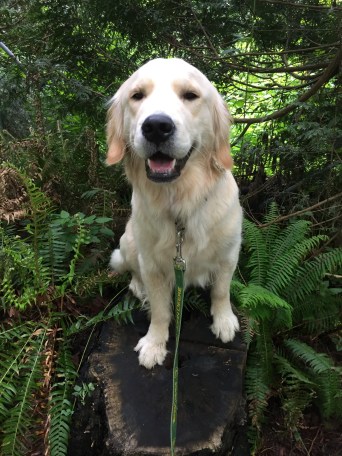
Kona balancing on an off-centre cut stump
Good dogs are well socialized dogs.
When most dog owners hear the word socialization, the image that immediately comes to mind is a group of dogs playing and mingling with each other, being social. But socialization is way more than simply having a dog play with and get along with other dogs. In the context of dog training, socialization means to habitually expose a dog in a positive manner, to a variety of situations, dogs, people, places experiences, sights, sounds and smells ( to name just a few) so that the dog becomes confident and comfortable while learning to behave in a way that is acceptable in any situation.
When most dog owners think of socialization, they think puppies! But socialization is not just for puppies, it is for adult dogs as well! Socialization is a life long affair and does not stop once a dog becomes an ‘adult’ because dogs remain social through socialization! Good dogs are dogs that are comfortable, calm and confident wherever they are. They are comfortable, calm and confident because their owners have made a concerted effort to socialize them to all the things they might enjoy together throughout the life of the dog. If you want to be able to enjoy a latte at the funky coffee shop with your dog at your side, you have to go and teach your dog how to behave in that situation as well as allow it to experience the sights, sounds, smells and activity of a coffee shop while it is behaving. To have a good dog, you have to deliberately seek out activities with your dog and allow him/her to experience them in a positive, calm manner.
I have horses and one day I want to be able to ride my horse with my dogs running along with us. But I have to start first by exposing them to the sight, smell, size and movement of a horse. In time both my dogs and horse will be comfortable and confident enough with each other that I can achieve this goal. But if I saddled my horse one day and out of the blue called my dogs along for the ride it would be a gong show! My horse would likely freak out at the dogs running around him and my dogs would be fearful or aggressive towards my horse, not cool and not safe!
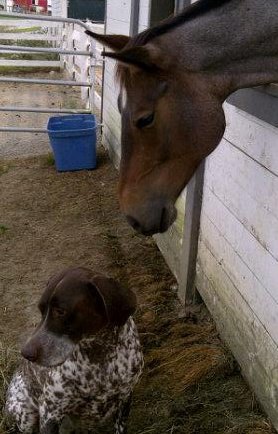
My boy Piper (RIP) and my horse Tex getting to know one another
Good dogs are well trained dogs
I can’t stress the importance of teaching your dog basic obedience commands, be it through a group class, a private trainer or watching a lesson on You-tube. A good obedience class will not only teach the basic commands such as sit, down, stay, come and heel. But once you learn these basic commands, it does not mean that your dog is magically trained, you have to actually use them by including them in your daily routine with your dog. For example, once you teach your dog the sit, you then ask it to sit before it gets its leash on, sit before going out the door, sit to be pet by a friendly stranger etc. When you diligently practice this you have a dog that is patient to get its leash on. A dog that calmly waits for the door to open without bolting into the street and a dog that does not jump up on people they meet. To the untrained eye, it seems like magic that the dog is so well behaved but in fact the dog has been conditioned, through implementing learned obedience exercises, to maintain self control. Obedience works, if you use it!
One of the most important obedience commands is the recall ( come when called) but people fail to train it properly and then only use it when the poop hits the fan! If you have only practiced your recall exercise in obedience class, or the back yard, it is ridiculous to expect your dog to come when called from playing with other dogs, or from chasing a squirrel. A reliable recall takes a really long time to train through a variety of increasing distractions. The majority of people just sort of give up on the training after their obedience class, and when the dog doesn’t come, begin to shout “Oh my dog is friendly!” instead of being responsible and proactive.
Want a good dog? Train your dog ever single day. There are plenty of opportunities in a day to work with your dog within your daily routine.
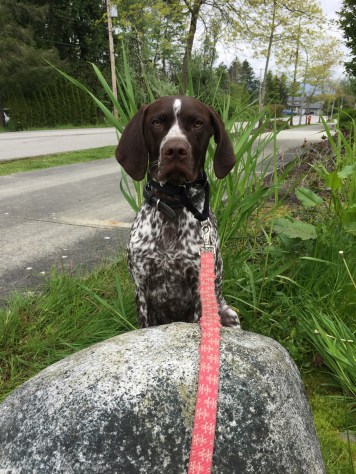
5 month old GSP Charlie practicing his wait while on a training walk
Good dogs are well exercised dog
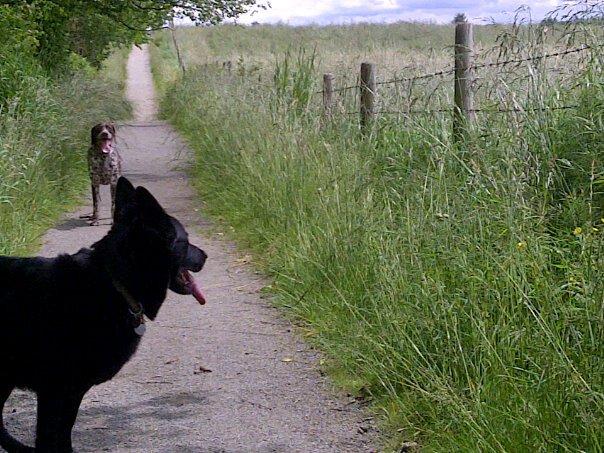
Unlike people, dogs love exercise and the great outdoors. It is true that some breeds of dogs have been so altered genetically that they can no longer tolerate even moderate forms of exercise due to compromised breathing or short legs but even those dogs love their slow-poke walkies. My dogs on the other hand, are all about the speed. I have a 3 year old German Shorthaired Pointer named Carter and a 4 year old Border Collie/Australian Shepherd/Blue Heeler cross named Raider. There is no way I would be able to make it through my day with my sanity and personal belongings intact if I did not take these two for their daily hikes. They are high drive, highly active and highly intelligent dogs. When my alarm goes off at 6:00am, they are at the door waiting before I get one foot out of bed!
It is so important to exercise your dog every single day and when I mean exercise, I mean more than a 30 minute walk around the block. Through my 20 + years of dog training experience, I have found that when a dog is exercised well, first thing in the morning, they are far less reactive, hyper and obnoxious throughout the day. The longer a dog has to wait for exercise, the more their anxiety and impatience increases and the more likely they are to be reactive and non compliant on a walk. The majority of my clients who have complained about their dogs being ‘out of control’ on a walk managed to fix the problem simply by taking the dog for a good long walk ( at least an hour) first thing in the morning. My clients have also happily reported some personal weight loss and health improvements with this routine change as well!
Don’t forget to exercise your dogs brain as well! Dogs exercise their brains in a variety of ways. Earlier I mentioned how Kona balances on stumps. I taught her this as a puppy as a way to build her confidence as well as keep her mental focus. When she is thinking of the obstacle under her feet she is using her brain. Kona also does tracking. If you want to have an amazing relationship with your dog, one that will be the envy of the neighbourhood, find a tracking class in your area and participate with your dog. You will thank me for it later. The side effect of tracking is that your dog looks at you as the most amazing human in the world because you taught them how to track. If you can’t find a tracking class, then teach your dog to locate their toys, or treats in the yard by using their nose.
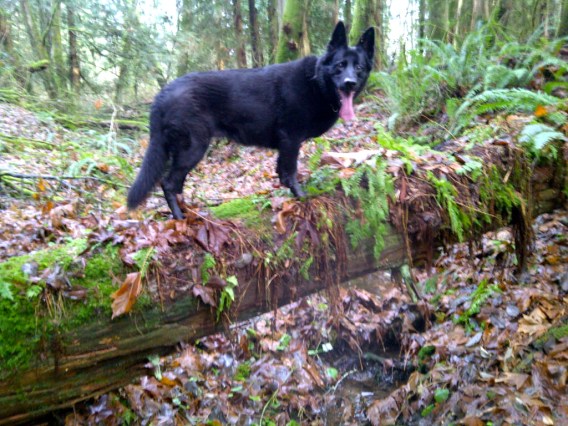
My 14 year old GSD Zumi, balancing on a log over a small creek during one of our off the beaten track forest hikes. That long tongue says she was working hard!
Good dogs have good boundaries
Boundaries and limitations are not and should not be considered a form of ‘dominance over a dog’. The words Dominance, Alpha, Pack Leader, Master, Top dog etc. have been so misinterpreted, and misused in so many incorrect ways over the years that they have become politically incorrect to utter in even the slightest form of conversation regarding dogs. The words themselves are not bad, the very old school abusive training associated with them is.
What boundaries and limitations mean is teaching a dog to limit their (human perceived) unwanted dog behaviours and live within the boundaries of a human existence creating a harmonious environment instead of a stressful one.
Not allowing a dog to rush up and down the stairs ahead of an owner is not saying Alpha humans first dogs second. What it is, is setting a boundary for the dog to limit its unwanted dog behaviour of rushing and teaching a dog to wait until the human passes, to encourage a natural wanted dog behaviour of patience. Yes a dog can be patient if given the opportunity.
A dog prevented from going out the door first, is not having dominance asserted over them but rather teaching a dog a natural wanted dog behaviour of self control by sitting and waiting to have their leash put on before they go out the door which will prevent them from expressing an unwanted dog behaviour of running into the street, chasing an animal, child, jogger etc. which may cause harm somehow. It also teaches a dog to look for direction and guidance, which are two wanted natural dog behaviours that dogs are more than willing to express if given the opportunity.
Not allowing dogs to run around the house like its a race track is not a “Master’ limiting a dogs enthusiasm but setting a boundary that uses a natural wanted dog behaviour of calm and peacefulness instead of the unwanted frenetic behaviour.
Limiting unwanted behaviours and encouraging wanted behaviours makes it easier for dogs and their person to understand one another. Dogs become more predictable as they begin to seek ways to express those wanted behaviours and illicit wanted behaviours from their person.
Setting boundaries for your dog to live within decreases stress for both dogs and humans. With limited stress a dog begins to engage more with their person.
When a dog seeks to engage with their person peace and harmony are created within the home and relationship shared by a dog and their person.

Raider, my Border Collie x Cattle dog pushing the boundaries of personal space!
Good dogs have good leaders
First of all, leadership is not dictatorship, it is not punishment, it is not brutish physical control, it is not denying of affection or attention and it is certainly not domination. It is true that I do use the word dominant or alpha when it comes to discussing humans and dogs but it is used in reference to a prevailing attitude or behaviour, not as an expression of dominion of one creature over another.
There was a time many decades ago when training dogs or horses was based on domination of the animals spirit, breaking them-making them so fearful that their will to survive was destroyed and the animal chose to rely on the human for their sheer existence or die. Humans did this because they were ignorant. Humans were taught that animals had no emotion or where capable of conscious thought or had free will. But thankfully due to the evolution of human education (and spiritually based modalities) times have changed. We now know that we can communicate with both dogs and horses -once we understand their language-and that they will willingly, without fear or coercion, give us what we ask of them because they trust us implicitly, no fear or intimidation involved.
Leadership means learning to communicate with your dog, to understand their needs and desires, to learn why they do what they do and if what they do does not result in positive wanted behaviour then to take the necessary actions to teach the dog a new way of behaving. It makes no difference if you use, a bag of treats, a clicker or simply praise and verbal encouragement, as long as the dog understands what is being asked from it and it learns.
In essence, the word leadership is simply another term for offering consistent guidance and direction so that a dog learns to trust in their person and through that trust, built on consistent guidance, a dog willingly follows direction with joy and peacefulness, the dog and owner become one, in kinship with one another. In reality there is no such thing as being ‘higher’ than the other, as one yields to the others knowledge and guidance because it trusts.
This is what I strive for when working with dogs and their people. To teach the human counterpart of the duo how to be consistent, patient, fair, benevolent and reliable and to trust in themselves so that their dog will have trust in them. Our dogs are speaking to us and asking for guidance all the time but because the majority of dog owners don’t know what to look for they can’t see the conversation taking place and the dogs get frustrated. This frustration often results in a dog expressing itself as a poorly behaved dog.
Leadership is also taking responsibility for your dogs behaviour as well as your own. It means admitting to yourself when your dog is not behaving appropriately instead of making excuses to yourself and others. Yelling towards another dog owner that your dog is friendly as you watch his back end run away from you is not leadership. This is denial. That is expecting others to do your job of managing your dogs behaviour for you because you never took the time to learn how to do it properly.
Being a leader to your dog is like being a parent to a child. You have to be able to find a balance between offering disciplined, consistent guidance and playful affectionate attention. Too much of one and not enough of the other throws the scales off and you end up becoming either a bully or a pushover.
A good leader is benevolent in everything that they do. This benevolence creates an environment of trust and a dog becomes a happy willing partner.
It is important to set boundaries for a dog but it is equally important to play and have fun with them. You cannot train a dog on love alone as this just creates an insecure, fearful dog who is constantly needing attention. You cannot train a dog on discipline alone as this creates a dull minded dog who gives up far to easily as it is always met with negativity. There has to be a healthy balance and the only way to find that balance is to really get to know your dog by spending quality time with them. Take holidays with your dog, go for road trips, visit friends and family with your dog. Cancel the dog walker and find the time in your day to walk your own dog!
Include your dog in your life as often as you can. This inclusion will develop a deep devotion from your dog and an unforgettable bond.
Become a good leader for yourself and your dog. Your relationship with your dog and in all areas of your life will only improve as a result.
Good dogs are not born, good dogs are made.
From Joan and her canine crew…keep yer tails waggin
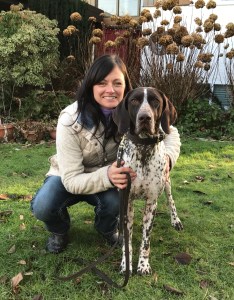
Me and my boy Carter
 K9 Kinship