
The more things change in the world of dog training, the more they stay the same. Over the 25 +years of my dog training career I have certainly seen an array of training methodologies. But regardless of these training methods, they all have the same goal which is applying obedience or boundaries, to help dog owners manage their dogs behaviour so that they can share their lives together peacefully and joyfully within society.
Wait , what? Did I just say Obedience was a boundary? Yes, yes I did.
But setting a boundary is forcing a dog to comply! ….Yes it is!
We all gotta get over the force free stuff right now. Force does not automatically create an unhealthy fear nor is it abuse. There is not one part of any creatures life on this planet that is not subjected to some degree of force every day. When you see a red light, it is expected that you stop at that red-light. In doing so you are being forced not to proceed into the intersection so that you can stay alive and also maintain the life of someone else that you might run into by entering the intersection against the boundary set by the red light. The fear of death or a ticket is the positive punishment that creates compliance to the red light. That is a healthy fear!
The sight of snow falling forces us to put on warmer clothing to prevent freezing. This is another healthy fear brought on by force.
Your alarm clock forces you to get out of bed with the fear of losing your job as the motivating factor for not complying to the alarm and is an example of a healthy fear, as the motivator to make better choices.
The difference with these examples of force, fear and punishment and training dogs is that we have become accustomed to living within the boundaries of them, that complying to them is automatic to the point that it seems inconceivable to live without them. We live within these boundaries and conform to the laws that create them quite comfortably because otherwise we would live in daily anarchy which creates anxiety and reactivity due to unhealthy fears of our safety and wellbeing. Boundaries of law allow us freedoms to live without unnecessary fears that compromise our quality of life. However, when it comes to training dogs we anthropomorphize in an unhealthy way by assuming we are restricting our dogs quality of life by forcing them to live within a boundary of conformity. Ironically we can see how conforming to laws and boundaries keeps us safe and allows for more freedom than living in an anarchist state. But we see rules for our dogs as subjugated obedience.
By adopting this misguided anthropomorphic view on boundaries we are inadvertently creating an anarchist state in our dogs lives when we don’t apply rules for them, which ends up creating anxiety, reactivity and unhealthy fears of personal safety.
Obedience commands are spoken boundaries of expected behaviour that a dog owner uses to manage their dogs throughout the day. This means that a dog is only as good as their obedience and equally only as good as an owner who uses it!
Obedience is something that your dog learns with the help of a trainer and the owner is expected to use not just at obedience class, but throughout the day for the dogs entire life to shape and manage the dogs behaviour so it learns, through consistent application of said commands, to make appropriate choices which creates order and safety and emotional freedom that in turn reduces anxiety and fear. Obedience is applying learned boundaries of behaviour.
The standard or basic obedience commands taught are Sit, Down, Wait/Stay, Place, Heel, Leave-it, Come when called often referred to as the Recall and a Release/Break. Yes there are many more, but these are the basics that we all start with.
All of these commands require that a dog alter its chosen behaviour to adhere to the command given. A dog who is standing is asked to sit. This sit alters the dog from a standing position. A dog then remains in that sit position until it is told to ‘Break’ and is released from the Sit. That simple change of position from a stand to a sit, upon direction from the owner, creates a boundary of expected behaviour for the dog to remain in for a period of time. That learned boundary can now be used to shape a dogs behaviour as it is applied to the over all lifestyle with the dog and its owner.
These boundaries of acceptable behaviour aka Obedience, can then be used to teach Impulse Control and Self Regulation. A dog that is told to sit at the threshold of a door that leads outside is not only being taught how to be polite and wait to be invited out the door, but the dog is also learning to control its impulse to bolt out an open door and thus prevent an unfortunate accident or death.
Obedience commands give a dog owner a level of control over their dog so that behaviours can be shaped and managed so that a dog is …well…obedient!
These obedience commands and boundaries of expected behaviour are also the foundation tools used to rehabilitate behaviours such as anxiety and reactivity , which is what I will discuss next time.
Happy trails and wagging tails!
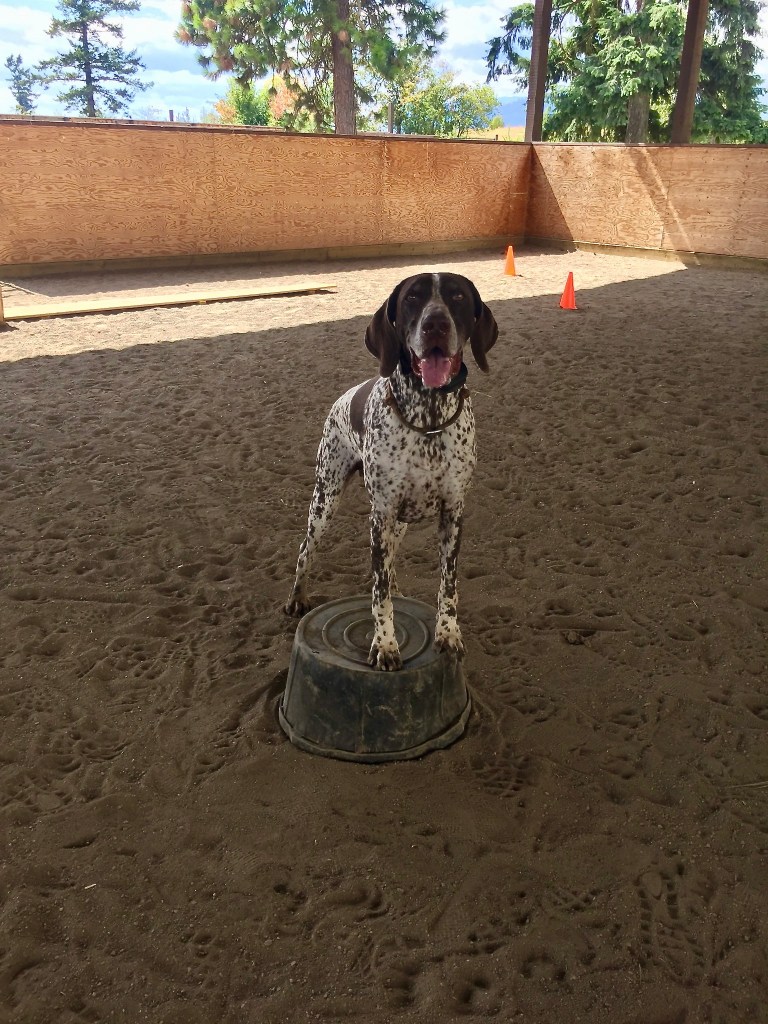
Image of Carter learning that his “Place” command means to go to a spot and stay there…even if its an upside down feed bucket!
 K9 Kinship